A few years ago, picking an API monitoring tool was simple. You wanted something that hit /health every five minutes and emailed you if the response code was not 200. That was the whole product category.
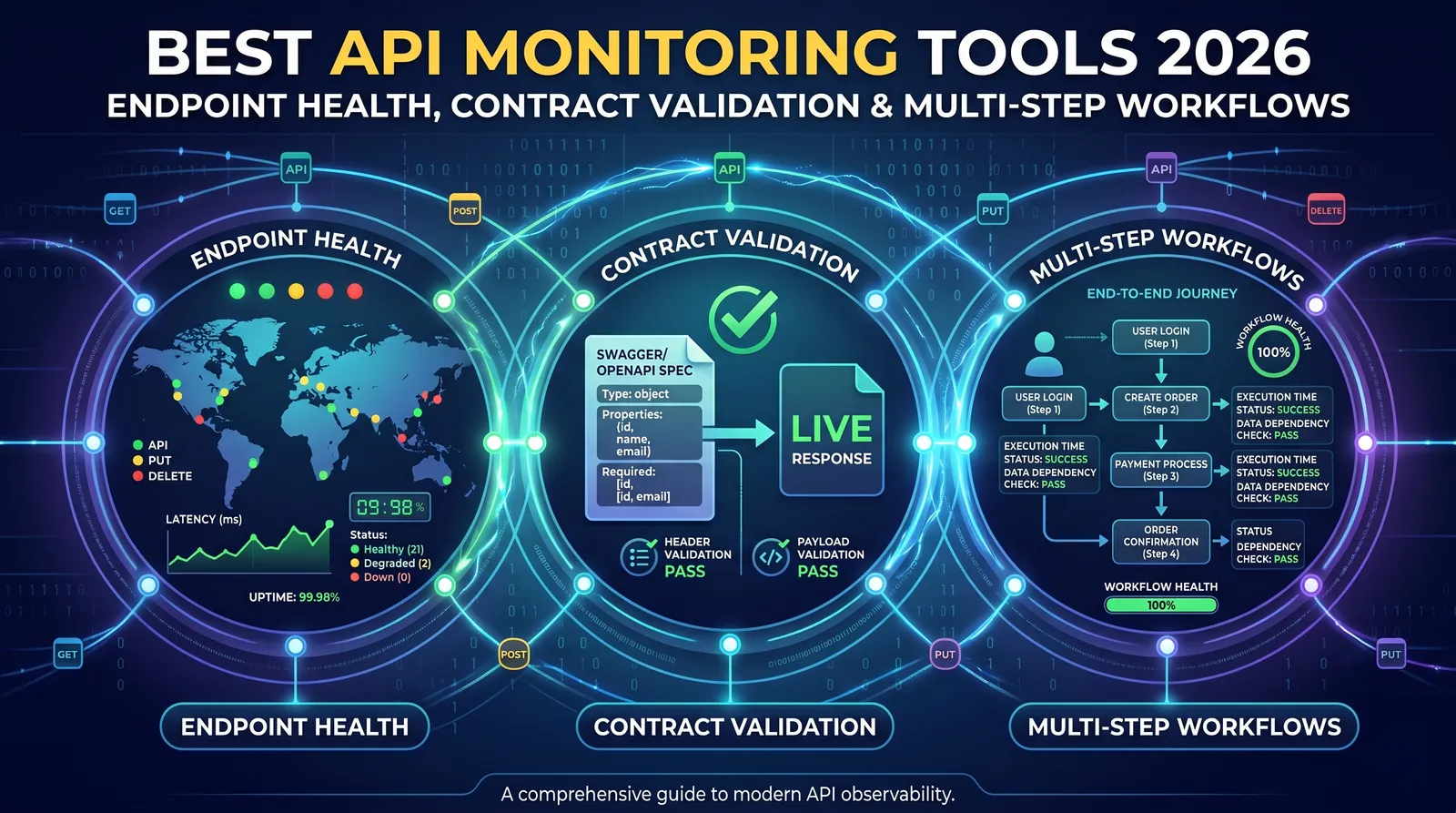
In 2026, that is no longer enough. Modern teams ship dozens — sometimes hundreds — of public APIs, internal microservices, third-party integrations, and increasingly, LLM-powered backend endpoints that other services call as agentic "tools". An HTTP 200 response can still mask a stale payload, a missing field, a slow downstream, or a regional CDN serving cached errors. Add the explosion of GraphQL alongside REST, gRPC inside service meshes, and authentication patterns that rotate tokens by the minute, and "API monitoring" stops being a single check and starts being a continuous contract.
The teams that ship reliable services this year are not asking "which /health pinger should we add?" They are asking "which platform can validate the response body, follow a real multi-step flow, handle our auth rotation, and deliver the alert into the same on-call rotation as the rest of our monitoring?"
In this guide, we rank the best API monitoring tools for 2026 — not just on whether they can hit a URL and check the status code. We rank them on response-body assertions, multi-step workflow support, authentication breadth, alerting intelligence, and honest price-to-value for a real team.
Why 2026 Is Different for API Monitoring
Three forces are reshaping API monitoring this year:
- API sprawl keeps compounding. A typical SMB now exposes a public REST API, a partner API, an internal GraphQL gateway, three Stripe-style webhooks, and a growing collection of LLM-facing endpoints that AI agents call as tools. Each is a contract that can break in a different way. Tools that bill per-monitor or cap you at 50 API checks force teams back into spreadsheets.
- A 200 response is not enough. Modern API failures are rarely "the service is down." They are stale cache, malformed payload, a missing field after a deploy, a slow downstream that pushes p95 latency past your SLO. Monitoring has to assert on the response body and percentile latency — not just
notAfter-style availability. - CFOs are auditing tool sprawl. API monitoring is one of the cheapest places to consolidate. If you are paying for a dedicated API monitor plus a separate uptime tool plus an APM vendor for synthetic checks plus a status page subscription, expect a budget conversation. The teams that get ahead of it are the ones already moving to a unified uptime + API + status page platform.
This is the lens we used to build the ranking below.
How We Evaluated These Tools
For each tool we scored five things:
- Assertion depth. Status code only, or full JSON-path assertions, regex matches, response schema validation, and latency thresholds?
- Multi-step workflows. Can you chain login → create → verify → delete in a single test, with variable passing between steps?
- Authentication breadth. Bearer / Basic / API keys are table stakes. OAuth 2.0 with token refresh, mTLS, and signed-request flows separate the serious tools.
- Adjacent monitoring. Does it also cover uptime, server, SSL, and status page needs, or is it the fourth subscription on top of three other tools?
- Honest pricing. Free tier, list pricing, per-check vs per-step billing, hidden enterprise gates.
The Top 10 API Monitoring Tools for 2026
1. Xitoring
Best for: All-in-one consolidation for SMBs and growing engineering teams.
Xitoring is built for the 2026 reality of API monitoring: real response-body assertions, multi-step flows, broad authentication support, and the alert lives in the same on-call rotation as your uptime, server, and SSL alerts. Where most API monitors force you to bolt on three or four other products to cover websites, servers, certificates, and status pages, Xitoring ships them as part of the same platform.
Key Features:
- Full HTTP method support — GET, POST, PUT, PATCH, DELETE with custom request bodies and headers.
- Response body assertions — verify JSON fields, regex matches, and patterns, not just the HTTP status.
- Authentication breadth — Bearer tokens, Basic auth, API keys, and custom header chains for authenticated endpoint monitoring.
- cURL-to-check converter — paste any working
curlcommand and Xitoring builds the monitor for you. No manual configuration. - Multi-step API checks — chain login → create → verify → delete in a single test, with variables passed between steps.
- Latency tracking with p50 / p95 / p99 breakdowns and SLA threshold alerts.
- 15+ global probing nodes so a regional CDN or DNS hiccup is caught, not averaged away.
- Unified with uptime, server, SSL, cronjob, and status page monitoring — one bill, one dashboard, one alerting rules engine.
Why it ranks #1: Xitoring wins the consolidation era on its main axis. A team replacing a dedicated API monitor + Pingdom + a separate status page + a cronjob watcher with Xitoring typically cuts monthly spend, drops dashboards from four to one, and consolidates alerting in a single rules engine. That is what 2026 monitoring is supposed to look like. Start free →
2. Postman Monitors
Best for: Teams already living in Postman collections.
Postman built the API world's most-used development tool, and its Monitors product turns collections you already have into scheduled production tests. If your team's API documentation, contract tests, and developer onboarding all live in Postman, monitoring them from the same surface is the natural progression.
Key Features:
- Run any existing Postman collection on a schedule.
- Reuse environments, variables, and pre-request scripts across dev and production tests.
- Newman-compatible — local CI runs and cloud monitors stay in sync.
- Integrated with Postman's API governance and contract-test features.
Verdict: A genuinely strong fit if Postman is already your team's API platform of record. Falls short of #1 because there is no native uptime, server, or SSL monitoring — Postman Monitors is only about API tests, so you will still need at least one other tool for the rest of the stack. Pricing also scales aggressively past the small "personal" tiers.
3. Checkly
Best for: Code-first and CI/CD-native engineering teams.
Checkly took the radical-for-its-time stance that synthetic checks should be code, not point-and-click forms. Built around a clean API for HTTP checks and Playwright for browser tests, Checkly slots beautifully into a CI/CD pipeline — monitors deploy with your application, live in version control, and get reviewed in pull requests.
Key Features:
- "Monitoring as code" — checks committed to your repo and deployed with your service.
- Powerful TypeScript-based assertions and setup/teardown scripts.
- Chained API requests with variable passing between steps.
- Tight CI integration so a failing check can block a deploy.
Verdict: A genuinely excellent product if your team's culture is engineering-first and you treat tests as code. Less of a fit if non-engineers need to set up monitors, and it is intentionally narrow — no server monitoring, no SSL grading, no cronjobs in the consolidated sense, so you will buy additional tools alongside it.
4. Datadog Synthetics
Best for: Teams already living inside Datadog.
If you have already paid the Datadog tax for infrastructure or APM, adding API Synthetics is the obvious move — alerts, dashboards, and incident context all live in the same place, and you can correlate a failing API check with the underlying service trace automatically.
Key Features:
- API tests with assertions on status, body, headers, and latency.
- Multi-step request chains with variable extraction.
- Deep correlation with Datadog metrics, traces, and logs.
- Powerful global locations including private locations behind firewalls.
Verdict: Only justifiable if Datadog is already your platform of record. Standalone, the cost-per-API-test is in another universe compared to anything else on this list, and the per-step billing model gets expensive fast on multi-step flows. Compare Xitoring vs Datadog →
5. Better Stack
Best for: Incident-led teams that want a polished modern UX.
Better Stack extended its uptime product into API monitoring with the same clean UX and incident-management depth. API alerts plug straight into on-call schedules and post-mortems alongside the rest of your incident workflow.
Key Features:
- API endpoint monitoring bundled with uptime checks.
- Response-time tracking and JSON assertions.
- Built-in on-call scheduling and escalation policies.
- Tight integration between API, uptime, and incident lifecycle.
Verdict: A genuinely strong product, especially if status pages and incident workflow are your primary pain. Falls short of #1 because multi-step flows are thinner, authentication options are narrower, and pricing scales aggressively once you add the adjacent monitoring products. Compare Xitoring vs Better Stack →
6. New Relic Synthetics
Best for: Teams already invested in the New Relic observability stack.
New Relic Synthetics offers scripted browser and API monitors with deep correlation back to the rest of the New Relic platform — traces, logs, infrastructure metrics, and APM data all stitched into a single view of what failed and why.
Key Features:
- Scripted API tests with full Node.js runtime for complex assertions.
- Multi-step monitors with chained requests.
- Strong correlation between failed checks and the underlying service traces.
- Private location support for internal APIs.
Verdict: Powerful if New Relic is already your observability platform of record. Standalone, the pricing model — usage-based across data ingest, users, and check executions — is hard to predict and tends to balloon, and the surface area is overkill for teams whose only need is "is this endpoint responding correctly?" Compare Xitoring vs New Relic →
7. UptimeRobot
Best for: The cheapest credible entry point.
UptimeRobot added "keyword" and basic HTTP body checks to its uptime monitors, which covers the simplest form of API monitoring — assert that a string is present in the response. For solo developers and tiny side projects, that is sometimes enough.
Key Features:
- Keyword and HTTP body checks on Pro plans.
- Generous free tier for basic uptime.
- Simple, fast onboarding.
Verdict: Hard to beat on price for single-purpose basic API checks. But the consolidation lens hurts it: there are no real multi-step flows, no JSON-path assertions, no auth-flow support beyond a static header, and the alerting engine is basic. You will end up buying two or three more tools alongside it. Compare Xitoring vs UptimeRobot →
8. Pingdom
Best for: Teams already invested in the SolarWinds ecosystem.
Pingdom offers API monitoring as part of its synthetic checks suite, with multi-step transaction support and detailed response analysis. The product is mature, alerting is reliable, and it shines when API monitoring is part of a broader RUM + synthetic stack already in production.
Key Features:
- Multi-step transaction monitoring with response validation.
- Real User Monitoring alongside synthetic checks.
- Page-speed monitoring with detailed waterfalls.
Verdict: Reliable, but feels its age in 2026. The interface has not modernized at the pace of newer competitors, and pricing is positioned for the enterprise — not the SMBs driving the consolidation trend. If you are starting fresh in 2026, you can get more for less elsewhere. Compare Xitoring vs Pingdom →
9. Site24x7
Best for: The closest all-in-one competitor to Xitoring.
Site24x7 (from ManageEngine) is the most direct philosophical competitor to Xitoring on this list. Its API monitor sits inside a broader platform covering uptime, server, network, APM, and cloud monitoring. If you came to this article looking for "the consolidated platform," Site24x7 belongs in your shortlist.
Key Features:
- API tests with response-body assertions and multi-step flows.
- Broad scope across uptime, server, network, APM, and cloud.
- Mature alerting and reporting features.
- Strong integration coverage for enterprise tools.
Verdict: A serious contender, especially for larger teams. The trade-off is complexity and learning curve — Site24x7 is a wide platform with many modules, where Xitoring focuses on doing the consolidated stack with a tighter, simpler product surface aimed squarely at SMBs and mid-market.
10. Assertible
Best for: Small teams that only need API checks and nothing else.
Assertible is a small, focused API monitoring product that does API tests and post-deployment validations well, without trying to be a full observability platform. It hits the same niche as a few of the tools above but stays narrow on purpose.
Key Features:
- JSON-path and response-schema assertions.
- GitHub deployment-trigger integration.
- Encrypted variables for auth credentials.
Verdict: Solid for teams that already have separate uptime, server, and SSL monitoring sorted, and only want a focused API monitor to add on. In 2026, the consolidation trend works against this kind of single-purpose tool — the marginal subscription is increasingly hard to justify when adjacent platforms cover the same ground.
At-a-Glance Comparison
| Tool | Body Assertions | Multi-Step Flows | Auth Breadth | cURL Import | Adjacent Monitoring | Free Tier |
|---|---|---|---|---|---|---|
| Xitoring | Yes | Yes | Yes | Yes | Yes | Yes |
| Postman Monitors | Yes | Yes | Yes | Yes | No | Limited |
| Checkly | Yes | Yes | Yes | Limited | No | Yes |
| Datadog Synthetics | Yes | Yes | Yes | Limited | Yes | Limited |
| Better Stack | Yes | Limited | Limited | No | Yes | Yes |
| New Relic Synthetics | Yes | Yes | Yes | Limited | Yes | Limited |
| UptimeRobot | Limited | No | Limited | No | Limited | Yes |
| Pingdom | Yes | Yes | Yes | No | Limited | No |
| Site24x7 | Yes | Yes | Yes | Limited | Yes | Yes |
| Assertible | Yes | Limited | Yes | No | No | Limited |
The pattern matches the broader monitoring trend: only a handful of products meaningfully cover both deep API testing and the adjacent monitoring scope a real team needs.
How to Choose the Right Tool for 2026
Three questions usually settle it:
- How complex are your API flows? A single
/healthendpoint check fits almost any tool. Multi-step authenticated flows with variable passing — login → create resource → verify → clean up — separate the serious tools from the toys. - What else is in your monitoring stack? If you already have a separate uptime tool, server monitor, status page, and SSL checker, adding yet another subscription for APIs is the kind of tool sprawl a 2026 budget review will flag. The consolidation play wins.
- Who writes the monitors? Engineering-only teams that treat tests as code may prefer a code-first product. Mixed teams where product managers, QA, or support engineers also need to set up checks benefit from a UI-first tool with a cURL importer.
For most teams in 2026 — anywhere from a handful of public APIs to a few hundred internal services — the right answer is the platform that does the most without making you assemble it.
For a deeper primer on the discipline itself, our What Is API Monitoring guide covers the definitions, why it matters, and the core techniques that distinguish modern API observability from naive /health pinging. For the broader monitoring buying decision, our Top 10 Uptime Monitoring Tools 2026 guide covers the consolidation thesis end-to-end.
Final Word: Stop Treating API Monitoring as a /health Check
The 2021 buying pattern — pick a cheap status-code pinger, hope the alert fires before the customer complaints do — does not survive contact with a 2026 production environment. API sprawl, response-body failures that hide behind HTTP 200s, authentication flows that rotate by the minute, and consolidation pressure on tool budgets all point the same direction.
That is exactly the gap Xitoring's API monitoring was built for: full HTTP method support, response-body assertions, multi-step authenticated workflows, a cURL-to-check converter, and percentile latency tracking — all under the same platform that handles uptime, servers, SSL, cronjobs, and status pages, at a price designed for SMBs rather than Fortune 500 procurement departments.
If you are mid-audit on your monitoring stack, this is the year to consolidate API monitoring into the same place as everything else. Your future on-call rotation — and your CFO — will thank you. Start a free Xitoring account →