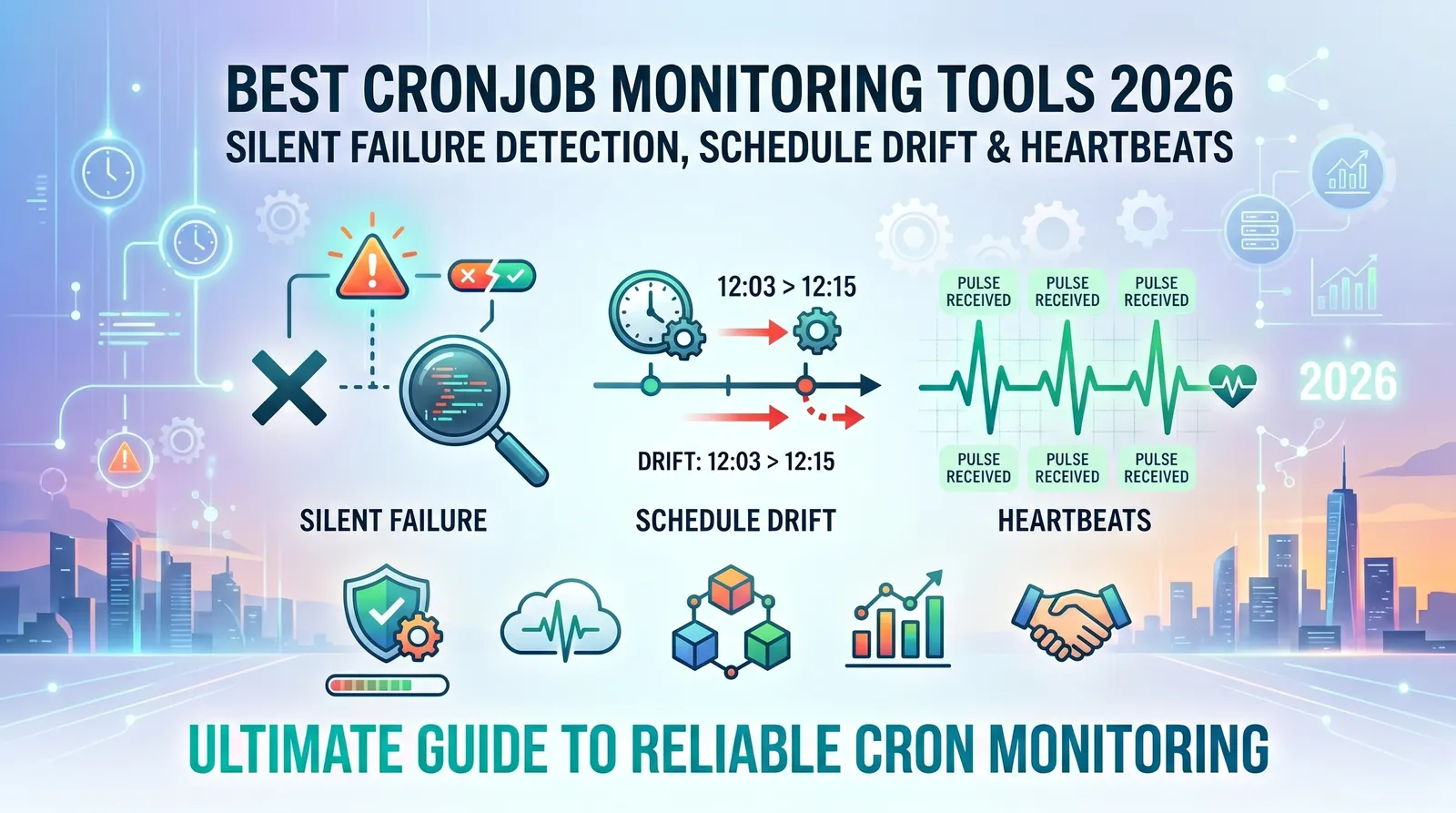
A few years ago, picking a cronjob monitor was a niche concern. You wrote 0 3 * * * /usr/local/bin/backup.sh, you hoped it ran, and you only found out it had been failing for a month when the customer asked for the backup that never existed. The whole category started as a workaround for cron's most embarrassing trait: silent failure.
In 2026, that pain has only grown. Modern teams run scheduled tasks across traditional Linux crontabs, Kubernetes CronJobs, GitHub Actions schedules, GitLab CI pipelines, Vercel cron functions, Cloudflare Workers Cron Triggers, AWS EventBridge rules, internal queue workers, and increasingly LLM-agent loops that fire on a schedule. Each of these can fail silently in its own way. A /health ping does not catch the one that matters: the job that never ran at all.
The teams that ship reliable backends this year are not asking "which cron emailer should we add?" They are asking "which platform watches every scheduled task we run, alerts us when one misses, runs late, or hangs — and delivers the alert into the same on-call rotation as the rest of our monitoring?"
In this guide, we rank the best cronjob monitoring tools for 2026 — not just on whether they accept a curl ping. We rank them on schedule tracking, silent-failure detection, duration alerting, integration breadth, and honest price-to-value for a real team.
Why 2026 Is Different for Cronjob Monitoring
Three forces are reshaping background-job monitoring this year:
- Scheduled tasks are sprawling across platforms. A typical SMB now runs cron on a Linux box and Kubernetes CronJobs and GitHub Actions schedules and Vercel cron functions and one or two queue workers polling on intervals. Each platform fails silently in its own way. A monitor that only ingests one of them is half a solution.
- Silent failures are the dominant failure mode. A job that exits cleanly but never ran, a job that ran twice because of a deploy, a job that hangs because a downstream API stalled — none of these throw an error to your log shipper. They show up days later when a downstream system notices missing data. The only defense is a monitor that knows the expected schedule and alerts on the gap.
- CFOs are auditing tool sprawl. Cron monitoring is one of the cheapest places to consolidate. If you are paying for a dedicated cron monitor plus a separate uptime tool plus a status page subscription plus an SSL checker, expect a budget conversation. The teams that get ahead of it are the ones already moving to a unified uptime + cron + SSL + status page platform.
This is the lens we used to build the ranking below.
How We Evaluated These Tools
For each tool we scored five things:
- Schedule tracking depth. Does it know your job's expected schedule and alert on missed runs — or does it only react when a heartbeat fails to arrive?
- Failure modes covered. Missed runs, late starts, long durations, short durations, non-zero exit codes, hung jobs — how many of these does the tool alert on natively, with separate thresholds for each?
- Integration breadth. A single
curlping covers basic crontabs. What about Kubernetes CronJobs, GitHub Actions schedules, Cloudflare Workers cron, Sentry / Honeycomb SDKs, and queue-worker heartbeats? - Adjacent monitoring. Does it also cover uptime, server, SSL, and status page needs, or is it the fourth subscription on top of three other tools?
- Honest pricing. Free tier, list pricing, per-check billing, hidden enterprise gates.
The Top 10 Cronjob Monitoring Tools for 2026
1. Xitoring
Best for: All-in-one consolidation for SMBs and growing engineering teams.
Xitoring is built for the 2026 reality of cronjob monitoring: schedule-aware checks, multiple separate alert thresholds per job, and the alert lives in the same on-call rotation as your uptime, server, and SSL alerts. Where most cron monitors force you to bolt on three or four other products to cover websites, servers, certificates, and status pages, Xitoring ships them as part of the same platform.
Key Features:
- Schedule tracking — define the expected cron expression, and Xitoring alerts when a job fails to check in on time. Not just heartbeat-on-arrival.
- Failure detection — both silent failures (job didn't run) and error exits (non-zero exit codes) detected automatically.
- Duration monitoring — track how long each execution takes; alert when it runs significantly longer or shorter than expected.
- Simple integration — add a single
curlcall to the end of any crontab entry. No SDK install, no code changes, no agent required. Works equally for Linux cron, Kubernetes CronJobs, GitHub Actions, queue workers, and AI-agent loops. - Execution history — full audit trail of every cron execution with timestamps, duration, and exit status for compliance and debugging.
- Smart notifications — configure alerts for missed runs, late starts, long durations, or error exits — each with its own threshold and channel routing.
- 15+ global probing nodes for related uptime and health checks on the downstream services your jobs depend on.
- Unified with uptime, server, SSL, API, and status page monitoring — one bill, one dashboard, one alerting rules engine.
Why it ranks #1: Xitoring wins the consolidation era on its main axis. A team replacing Cronitor + Pingdom + a separate status page + a server monitor with Xitoring typically cuts monthly spend, drops dashboards from four to one, and consolidates alerting in a single rules engine. That is what 2026 monitoring is supposed to look like. Start free →
2. Cronitor
Best for: Teams that want a category specialist's depth without the broader platform.
Cronitor effectively defined the modern cronjob monitoring category. The product is well-engineered, the dashboard is purpose-built for scheduled tasks (not bolted on to a generic uptime UI), and it ships SDKs for Python, Ruby, Go, PHP, and Node alongside the standard curl ping.
Key Features:
- Schedule-aware monitoring with rich cron expression support.
- Telemetry SDKs for major languages.
- Heartbeat and job-run telemetry models.
- Built-in incident management for cron-specific failures.
Verdict: A genuinely strong product if your only monitoring need is cron and you want a specialist's depth. Falls short of #1 in 2026 because it is just cron — you will still buy a separate uptime tool, SSL monitor, and status page. The marginal subscription is increasingly hard to justify as the consolidation trend continues.
3. Healthchecks.io
Best for: Open-source-friendly teams and self-hosters.
Healthchecks.io is the open-source-leaning option in this space. The hosted product is generous on the free tier, the source code is on GitHub (Django + Python), and you can self-host it on a $5 VPS if you'd rather not depend on yet another SaaS for your most boring jobs.
Key Features:
- Hosted SaaS and fully open-source self-host option (BSD-3-Clause).
- Schedule-based checks with cron expression support.
- Generous free tier (20 checks).
- Simple
curland email ping interfaces.
Verdict: A great pick for solo developers, hobby projects, and teams that genuinely benefit from self-hosting (regulated industries, air-gapped environments). For a typical SMB engineering team in 2026, the operational cost of running your own monitoring tool eats whatever you'd save vs a consolidated platform.
4. Dead Man's Snitch
Best for: Teams that want the simplest possible heartbeat monitor.
Dead Man's Snitch is the original "minimum viable cron monitor" — you create a snitch, get a unique URL, and curl it from your cron job. If the curl stops arriving on schedule, the snitch fires. That's the whole product, by design.
Key Features:
- Dead-simple URL-based heartbeat.
- Clean, opinionated UI.
- Email and basic webhook alerting.
Verdict: Lovable for what it is, and still a fine pick for a handful of personal crons. In a 2026 production environment, the lack of schedule-awareness, duration tracking, and adjacent monitoring makes it the wrong starting point for any team beyond the smallest.
5. Better Stack
Best for: Incident-led teams that want a polished modern UX.
Better Stack added heartbeat monitoring to its broader uptime + incident product. Cron alerts plug straight into on-call schedules and post-mortems alongside the rest of your incident workflow, which is a real strength compared to specialist-only tools.
Key Features:
- Heartbeat monitors bundled with uptime checks and status pages.
- Built-in on-call scheduling and escalation policies.
- Tight integration between heartbeat, uptime, and incident lifecycle.
Verdict: A genuinely strong product, especially if status pages and incident workflow are your primary pain. Falls short of #1 because schedule-tracking depth is thinner than the specialists' and pricing scales aggressively once you add the adjacent monitoring products. Compare Xitoring vs Better Stack →
6. Sentry Cron Monitors
Best for: Teams already living in Sentry for error tracking.
Sentry added cron monitoring to its error-tracking platform, with native SDK support across the same languages already used for exception capture. If Sentry is already in every service, adding a heartbeat is a one-line addition.
Key Features:
- Native SDK integration for Python, JS, Go, Ruby, and others.
- Cron failures correlate with the underlying error events automatically.
- Reuses Sentry's existing alert rules and integrations.
Verdict: Excellent fit if Sentry is already your error platform of record. Standalone it makes no sense — and even with Sentry in place, the cron-specific UX is thinner than the specialists', and you still don't get uptime or SSL or status pages.
7. Datadog
Best for: Teams already living inside Datadog.
Datadog supports cron monitoring via heartbeat checks and integration with its broader Synthetic, Logs, and Watchdog features. As with every Datadog product, it shines when correlated with the rest of the platform — a missed cron correlates to a deploy event, a slow downstream, or an infrastructure metric instantly.
Key Features:
- Heartbeat monitors with deep correlation to traces, logs, and infrastructure metrics.
- Anomaly detection on cron duration and frequency.
- Powerful integrations with Kubernetes, AWS, and the rest of cloud-native infra.
Verdict: Only justifiable if Datadog is already your platform of record. Standalone, the cost-per-monitor is in another universe compared to anything else on this list, and the feature gates designed for the enterprise feel especially painful for what should be a routine ops task. Compare Xitoring vs Datadog →
8. UptimeRobot
Best for: The cheapest credible heartbeat entry point.
UptimeRobot added a "heartbeat" monitor type to its uptime product, which covers the basic heartbeat-on-arrival case. For solo developers and very small teams, that is sometimes enough.
Key Features:
- Heartbeat monitors on most paid plans.
- Generous free tier for basic uptime.
- Simple, fast onboarding.
Verdict: Hard to beat on price for single-purpose basic heartbeats. But the consolidation lens hurts it: there is no schedule-aware tracking, no separate duration alerts, and no built-in execution history. You will end up buying two or three more tools alongside it. Compare Xitoring vs UptimeRobot →
9. Site24x7
Best for: The closest all-in-one competitor to Xitoring.
Site24x7 (from ManageEngine) is the most direct philosophical competitor to Xitoring on this list. Its cron and heartbeat monitors sit inside a broader platform covering uptime, server, network, APM, and cloud monitoring. If you came to this article looking for "the consolidated platform," Site24x7 belongs in your shortlist.
Key Features:
- Heartbeat monitors with adjustable intervals.
- Broad scope across uptime, server, network, APM, and cloud.
- Mature alerting and reporting features.
- Strong integration coverage for enterprise tools.
Verdict: A serious contender, especially for larger teams. The trade-off is complexity and learning curve — Site24x7 is a wide platform with many modules, where Xitoring focuses on doing the consolidated stack with a tighter, simpler product surface aimed squarely at SMBs and mid-market.
10. PagerDuty Heartbeats
Best for: Alerting-led teams already standardized on PagerDuty.
PagerDuty's heartbeat monitors aren't a full cron monitoring product — they are a building block within PagerDuty's incident-response platform. You curl the heartbeat URL on schedule, and if it stops, an incident gets created with all the on-call routing, escalations, and post-mortem workflow PagerDuty is known for.
Key Features:
- First-class integration with PagerDuty incident workflow.
- On-call schedules and escalation policies built in.
- Webhook-friendly for arbitrary scheduled tasks.
Verdict: Great if PagerDuty is already your alerting platform of record and you want the cron alert to land in the same incident pipeline. Not a serious choice as a standalone — there is no schedule-awareness beyond the heartbeat interval, no duration tracking, and the pricing is incident-volume-based rather than monitor-based.
At-a-Glance Comparison
| Tool | Schedule-Aware | Silent-Failure Detection | Duration Alerts | Execution History | Adjacent Monitoring | Free Tier |
|---|---|---|---|---|---|---|
| Xitoring | Yes | Yes | Yes | Yes | Yes | Yes |
| Cronitor | Yes | Yes | Yes | Yes | No | Limited |
| Healthchecks.io | Yes | Yes | Limited | Yes | No | Yes |
| Dead Man's Snitch | Limited | Yes | No | Limited | No | Yes |
| Better Stack | Limited | Yes | Limited | Yes | Yes | Yes |
| Sentry Crons | Yes | Yes | Limited | Yes | No | Limited |
| Datadog | Yes | Yes | Yes | Yes | Yes | Limited |
| UptimeRobot | No | Yes | No | Limited | Limited | Yes |
| Site24x7 | Limited | Yes | Limited | Yes | Yes | Yes |
| PagerDuty Heartbeats | No | Yes | No | Limited | No | No |
The pattern matches the broader monitoring trend: only a handful of products meaningfully cover both schedule-aware cron monitoring and the adjacent monitoring scope a real team needs.
How to Choose the Right Tool for 2026
Three questions usually settle it:
- Do you actually know your jobs' schedules? Heartbeat-on-arrival monitors are fine for hobby crons. Anything that runs on a real production schedule — backups, billing rollups, ETL pipelines, AI-agent loops — benefits dramatically from schedule-aware monitoring that alerts on the gap, not just on a downstream timeout.
- What else is in your monitoring stack? If you already have a separate uptime tool, server monitor, status page, and SSL checker, adding yet another subscription for cron is the kind of tool sprawl a 2026 budget review will flag. The consolidation play wins.
- How many runtimes are your jobs spread across? A team running everything on a single Linux box can get away with almost any tool. Teams whose jobs span traditional cron + Kubernetes CronJobs + GitHub Actions schedules + queue workers need a tool whose primitives don't assume one specific runtime.
For most teams in 2026 — anywhere from a handful of nightly backups to dozens of distributed background workers — the right answer is the platform that does the most without making you assemble it.
For deeper guidance on cron failure patterns themselves, our Cronjob Silent Failures guide covers the failure classes worth alerting on, and our Cronjob Monitoring Use Cases 2026 piece walks through the real scenarios where modern teams deploy cron monitoring. For the broader monitoring buying decision, our Top 10 Uptime Monitoring Tools 2026 guide covers the consolidation thesis end-to-end.
Final Word: Stop Discovering Failed Cron Jobs From Your Customers
The 2021 buying pattern — pipe the cron output to an email alias, hope the inbox filter doesn't eat it, and find out a month later that the backup hasn't run — does not survive contact with a 2026 production environment. Background jobs sprawling across runtimes, silent failures hiding behind clean log shippers, and consolidation pressure on tool budgets all point the same direction.
That is exactly the gap Xitoring's cronjob monitoring was built for: schedule-aware tracking, silent-failure detection, duration alerts, full execution history, and one-line curl integration that works with any runtime — all under the same platform that handles uptime, servers, SSL, APIs, and status pages, at a price designed for SMBs rather than Fortune 500 procurement departments.
If you are mid-audit on your monitoring stack, this is the year to consolidate cron monitoring into the same place as everything else. Your future on-call rotation — and your CFO — will thank you. Start a free Xitoring account →