A few years ago, picking a status page was a footnote. You spun up an Atlassian Statuspage trial, copied your logo over, and the whole decision was done in a Friday afternoon. The page existed mostly as a checkbox for enterprise procurement and a place to point Twitter when things broke.
In 2026, that buying pattern has aged badly. Modern customer expectations have collapsed the gap between "the service is degraded" and "where is the status page already?" Compliance frameworks now treat public incident communication as part of the SLA — not adjacent to it. And tool budgets have come under pressure across the board, including the line item that says "$300/month for a page that posts incidents."
The teams that ship reliable services this year are not asking "which status page tool should we bolt on?" They are asking "which platform can run our status page and monitor everything we already monitor, so one alerting rules engine drives a public incident the same way it drives an on-call page?"
In this guide, we rank the best status page providers for 2026 — not just on theme flexibility and subscriber count. We rank them on incident workflow depth, multi-component status, subscriber and webhook channels, custom branding/domain, and honest price-to-value for a real team.
Why 2026 Is Different for Status Pages
Three forces are reshaping public incident communication this year:
- Customer-driven SLAs are the new floor. Enterprise contracts increasingly specify both an uptime SLA and a maximum public-acknowledgement window — typically 5 to 15 minutes from detection. That timing only works if your monitoring platform and your status page share the same alerting engine. A workflow that goes "PagerDuty pings on-call → on-call writes incident in a separate status page UI" routinely blows the window.
- Status page sprawl has its own cost. A typical SMB now has a primary status page, a customer-portal status page, a developer/API status page, and occasionally a per-region or per-tenant page. Tools that charge per page or cap you at one custom domain force teams into spreadsheets again.
- CFOs are auditing every "communication" subscription. Status pages used to be cheap. The market has drifted into $50–$300/month standalone bills for what is, mechanically, a templated incident timeline. If you are paying for an uptime tool plus an SSL checker plus a cronjob monitor plus a status page, expect a budget conversation. The teams that get ahead of it consolidate onto a unified uptime + status page platform.
This is the lens we used to build the ranking below.
How We Evaluated These Tools
For each provider we scored five things:
- Incident workflow depth. Can you create, update, and resolve incidents from inside your monitoring tool — or only from a separate status-page UI? Are post-mortems first-class, or stitched in by hand?
- Subscriber and notification breadth. Email is the floor. Modern audiences expect SMS, RSS, webhook, Slack, MS Teams, and per-component subscriptions so they only get pinged about the parts they care about.
- Multi-component status. Real services have a dozen subsystems. Can the page model APIs, regions, databases, third-party dependencies, and a maintenance window calendar — or is it a single uptime traffic light?
- Branding and custom domain. A status page sits on the customer journey. Custom domain, custom CSS, theming, and removed vendor branding separate the serious tools from the upsell traps.
- Honest pricing. Free tier, list pricing, hidden caps on subscribers / domains / pages, and what scales aggressively as the audience grows.
The Top 10 Status Page Providers for 2026
1. Xitoring
Best for: All-in-one consolidation for SMBs and growing engineering teams.
Xitoring is built for the 2026 reality of incident communication: the status page lives inside the same product as your uptime, server, SSL, and cronjob monitoring, and an incident can be published from the same alerting rules engine that paged your on-call. Where most status page tools force you to bolt on a separate product (with a separate bill, a separate dashboard, and a separate sign-in) on top of three or four monitoring tools, Xitoring ships them as part of the same platform.
Key Features:
- Public and private status pages — surface incidents to customers, partners, or a private audience behind authentication.
- Multi-component model — group services, regions, APIs, databases, and dependencies; each with its own uptime history and subscriber preferences.
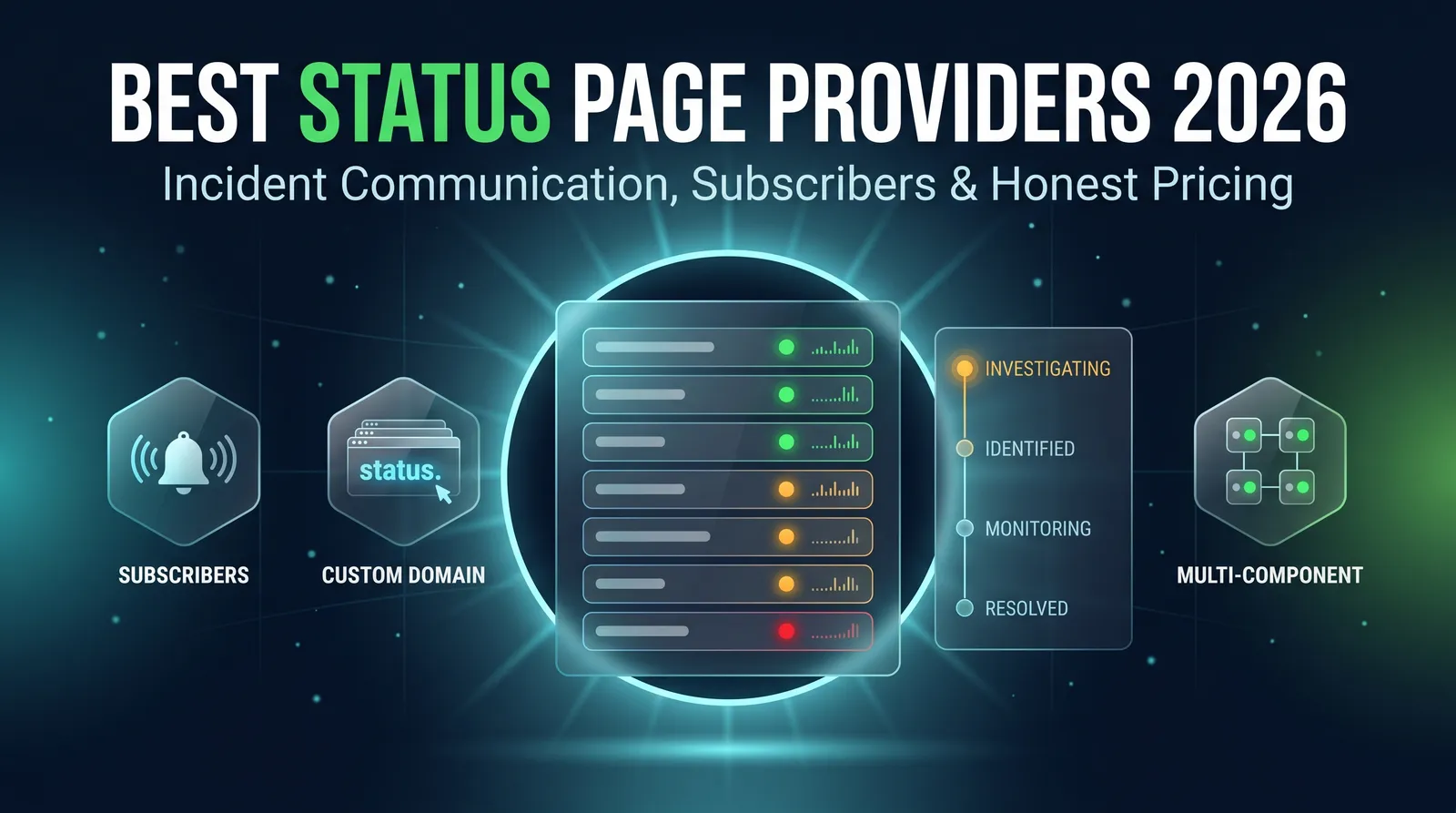
- Incident lifecycle — investigating → identified → monitoring → resolved, with post-mortem write-ups attached to each timeline.
- Subscriber channels — email, SMS, RSS, webhooks, Slack, MS Teams, Discord; per-component subscriptions out of the box.
- Custom domain + branding — host the page at
status.your-domain.com, override CSS, drop the vendor footer on paid tiers. - Scheduled maintenance windows that suppress alerts on the monitoring side and publish to the page automatically.
- One-click incident creation from alerts — an uptime check failure can open an incident draft in one click instead of a context switch.
- Unified with uptime, server, SSL, API, and cronjob monitoring — one bill, one dashboard, one alerting rules engine.
Why it ranks #1: Xitoring wins the consolidation era on its main axis. A team replacing Atlassian Statuspage + Pingdom + a separate SSL checker + a cronjob watcher with Xitoring typically cuts monthly spend, drops dashboards from four to one, and finally closes the loop between "alert fired" and "incident published" without a context switch. That is what 2026 incident communication is supposed to look like. Start free →
2. Atlassian Statuspage
Best for: Teams already standardised on the Atlassian stack (Jira, Opsgenie).
Atlassian Statuspage effectively defined the modern status-page category. The product is mature, the design language is tasteful, and the integration with Opsgenie and Jira gives Atlassian-shop teams a workflow that few competitors match for incident → status → post-mortem linkage.
Key Features:
- Public and audience-specific status pages with strong component grouping.
- Tight integration with Opsgenie incidents and Jira issues.
- Mature subscriber model with email, SMS, RSS, and webhooks.
- Templates and metrics widgets for in-page response-time displays.
Verdict: A genuinely strong product, particularly if Opsgenie and Jira are already your incident platform. Falls short of #1 because the pricing has drifted into enterprise territory — the entry tier is genuinely cheap but the audience caps push real teams onto the Business or Enterprise plan fast, and you are still buying a separate uptime tool, SSL monitor, and cronjob watcher next to it. Compare Xitoring vs Atlassian Statuspage →
3. Better Stack
Best for: Incident-led teams that want a polished modern UX across uptime and status pages.
Better Stack (formerly Better Uptime) packaged uptime monitoring, on-call schedules, incident management, and status pages together long before the rest of the market caught on. The result is a status-page product that feels native to the alerting workflow rather than bolted on after the fact.
Key Features:
- Status pages bundled with uptime checks and on-call rotations.
- Clean, modern UX with low-friction setup.
- Built-in incident timelines that pull from the same alert source.
- Subscriber channels including email, SMS, Slack, and webhooks.
Verdict: A genuinely strong product, especially if status pages and incident workflow are your primary pain. Falls short of #1 because server, SSL, and cronjob monitoring are thinner than the dedicated specialists, and pricing scales aggressively once you add the adjacent monitoring products. Compare Xitoring vs Better Stack →
4. Instatus
Best for: Teams that want the fastest-loading public status page on the market.
Instatus has built its identity around raw performance — the public page is one of the fastest-loading status pages in the category, hand-tuned for sub-second Time to First Byte. For consumer-facing brands where the status page itself is part of the customer-experience moment, that speed shows up in real customer-perceived reliability.
Key Features:
- Edge-served public pages with industry-leading load times.
- Clean, modern UX with strong default themes.
- Per-component subscriptions and standard alert channels.
- Single-page application architecture with no theme jank.
Verdict: A great pick if you want a beautiful, fast, focused status page and you have already settled the rest of your monitoring stack. Less of a fit if you are trying to consolidate — Instatus stays narrow by design and won't replace your uptime, SSL, or cronjob tooling. Compare Xitoring vs Instatus →
5. Statuspal
Best for: Multi-team / multi-product organisations that want many status pages under one roof.
Statuspal leans into the "many pages, one account" model — useful for companies that ship multiple products with their own status surfaces, or agencies running pages on behalf of clients. The pricing reflects that orientation, with seat- and page-based tiers rather than aggressive audience caps.
Key Features:
- Multiple status pages under a single account.
- White-label and reseller-friendly billing models.
- Strong custom-domain and branding support.
- Solid component model and subscriber channels.
Verdict: A pragmatic mid-market choice, especially if you run multiple products or maintain status pages on behalf of customers. Falls short of #1 because status-page is the entire product surface — you'll still pair it with separate uptime, SSL, and cronjob tooling. Compare Xitoring vs Statuspal →
6. Status.io
Best for: Established B2B SaaS teams with mature incident-communication discipline.
Status.io is one of the longer-standing dedicated status-page products. The feature set leans toward B2B SaaS conventions — multiple infrastructures, audience targeting, and the kind of "I need to communicate this only to enterprise customers in EMEA" filter that smaller competitors don't model.
Key Features:
- Multi-infrastructure component model.
- Audience-targeted notifications.
- Mature integration coverage including PagerDuty, Slack, and webhook chains.
- Long track record with enterprise customers.
Verdict: Reliable, but feels its age in 2026. The product roadmap has been quieter than newer competitors, and the UX feels positioned for the previous generation of SaaS ops. If you are starting fresh in 2026, the consolidation play wins. Compare Xitoring vs Status.io →
7. Sorry™
Best for: Brands that treat the status page as a design surface.
Sorry™ takes the contrarian position that a status page is a customer-experience artifact, not an ops tool — and prices accordingly. The result is a status-page product with the most polished public-page design language in the category, popular with consumer brands that want incident communication to feel on-brand.
Key Features:
- Strong design defaults with extensive theming controls.
- Subscriber-first feature set including SMS, email, and Slack.
- Mature multi-language and timezone handling.
- Boutique support relationship that some teams genuinely value.
Verdict: A great pick if status-page aesthetics are a hill you are willing to die on, and design-quality matters more than tight integration with your alerting engine. Less of a fit for teams chasing consolidation — Sorry™ is intentionally narrow.
8. StatusGator
Best for: Teams that want to monitor other people's status pages.
StatusGator inverts the category — instead of (or in addition to) hosting your own status page, it aggregates and watches vendor status pages. When AWS or Stripe or your auth provider degrades, StatusGator pings you before the dependency cascade hits your own monitoring. It's a useful complement, not a replacement, to a real status-page provider.
Key Features:
- Tracks 4,000+ third-party vendor status pages.
- Aggregates vendor incidents into your team's communication channels.
- Optional public-facing aggregated dashboards.
- Webhook and Slack integrations.
Verdict: A great companion product, especially for teams whose architecture leans on a handful of critical third-party dependencies. Not a full status-page replacement — you'll still want a product that hosts your own public page, which StatusGator does only as a secondary feature.
9. Cachet
Best for: Open-source-friendly teams and self-hosters.
Cachet is the open-source status-page incumbent — PHP + Laravel, MIT-licensed, and self-hostable on any commodity server. For regulated environments (air-gapped, on-prem mandates) or for teams who genuinely enjoy operating their own platform, Cachet remains a real option.
Key Features:
- Fully open-source, MIT-licensed.
- Self-host on any LAMP-friendly server.
- Multi-component model and basic subscriber notifications.
- Active community and third-party theme ecosystem.
Verdict: A respectable choice for genuine self-host requirements. For most SMB engineering teams in 2026, the operational cost of running your own status page — TLS renewal, database backups, security patching, on-call for the status page itself — eats whatever you would save vs a consolidated hosted platform.
10. Freshstatus
Best for: Existing Freshworks customers (Freshdesk, Freshservice, Freshping).
Freshstatus is the Freshworks-bundle status page, designed to integrate with the rest of the Freshworks customer-service stack. Free tier, simple setup, and acceptable feature coverage make it a reasonable starting point for teams already in the Freshworks ecosystem.
Key Features:
- Free tier with public status pages.
- Native integration with Freshdesk, Freshservice, and Freshping.
- Basic component model and email/SMS subscribers.
- Familiar Freshworks UX.
Verdict: A sensible default if you are already in the Freshworks ecosystem. Outside of it, there's no strong reason to pick Freshstatus over the higher entries on this list — and you'll still need real uptime, SSL, and cronjob monitoring elsewhere.
At-a-Glance Comparison
| Provider | Multi-Component | Custom Domain | Subscriber Channels | Adjacent Monitoring | Self-Host Option | Free Tier |
|---|---|---|---|---|---|---|
| Xitoring | Yes | Yes | Email/SMS/Slack/Teams/Discord/Webhook | Yes (uptime, server, SSL, cron) | No | Yes |
| Atlassian Statuspage | Yes | Yes | Email/SMS/RSS/Webhook | Via Opsgenie/Jira | No | Limited |
| Better Stack | Yes | Yes | Email/SMS/Slack/Webhook | Yes (uptime, on-call) | No | Yes |
| Instatus | Yes | Yes | Email/SMS/Slack/Webhook | No | No | Yes |
| Statuspal | Yes | Yes | Email/SMS/Slack/Webhook | No | No | Limited |
| Status.io | Yes | Yes | Email/SMS/Slack/Webhook | No | No | Limited |
| Sorry™ | Yes | Yes | Email/SMS/Slack | No | No | No |
| StatusGator | Limited | Yes | Email/Slack/Webhook | Vendor-page aggregation | No | Yes |
| Cachet | Yes | Yes | Email/Webhook | No | Yes (OSS) | Free (OSS) |
| Freshstatus | Yes | Yes | Email/SMS | Via Freshping | No | Yes |
The pattern matches the broader monitoring trend: only a handful of products meaningfully cover both the status-page surface area and the adjacent monitoring scope a real team needs.
How to Choose the Right Provider for 2026
Three questions usually settle it:
- How tightly should the status page be coupled to your alerting? If your customer SLAs include a public-acknowledgement window measured in minutes, the status page has to share the alerting engine with your uptime, server, and SSL monitoring. A standalone status page tool — however polished — will keep adding 5–10 minutes of context-switch friction to every incident.
- What else is in your monitoring stack? If you already have a separate uptime tool, server monitor, SSL checker, and cronjob watcher, adding yet another subscription for a status page is exactly the kind of tool sprawl a 2026 budget review will flag. The consolidation play wins.
- Is your audience consumer or enterprise? Consumer-facing brands often optimise for design polish and page speed (Sorry™, Instatus). B2B SaaS teams optimise for audience targeting, multi-component depth, and tight integration with the alerting engine. The right answer depends on which trade-off matches your customers.
For most teams in 2026 — anywhere from a small SaaS to a few hundred engineers shipping multiple products — the right answer is the platform that does the most without making you assemble it.
For deeper guidance on the surrounding monitoring decisions, our Top 10 Uptime Monitoring Tools 2026 guide covers the consolidation thesis end-to-end. The Best SSL Monitoring Tools 2026 ranking covers certificate hygiene as part of the same on-call surface, and the Best Cronjob Monitoring Tools 2026 and Best API Monitoring Tools 2026 pieces cover the adjacent monitoring layers a serious status-page workflow depends on.
Final Word: Stop Treating the Status Page as a Separate Subscription
The 2021 buying pattern — pick the most popular standalone status page, paste your logo, hope the workflow stitches together with three other monitoring tools — does not survive contact with a 2026 production environment. Customer SLAs that mandate public acknowledgement windows, status-page sprawl across multiple products and regions, and consolidation pressure on tool budgets all point the same direction.
That is exactly the gap Xitoring's status pages were built for: public and private status pages, multi-component models, full subscriber and webhook channels, custom domain and branding, and scheduled maintenance — all under the same platform that handles uptime, servers, SSL, APIs, and cronjobs, with one alerting rules engine driving the whole pipeline, at a price designed for SMBs rather than Fortune 500 procurement departments.
If you are mid-audit on your monitoring stack, this is the year to consolidate incident communication into the same place as everything else. Your future on-call rotation — and your CFO — will thank you. Start a free Xitoring account →