Xitoring CLI
Xitoring CLI is a Node.js command-line interface (CLI) tool for interacting with Xitoring's services.
It works on Windows, macOS, and Linux.
Installation
npm install -g xitoring-cli
This installs the xitoring-cli tool globally. After installation, you can run it using:
xitoring
More information can be found on npmjs.com.
Requirements
A Xitoring account is required to use the CLI.
Getting Started
- Install
xitoring-cliusing npm (or any package manager). - Authenticate with your Xitoring account:This provides a browser link to log in and obtain an API key.
xitoring login - Start using commands to interact with your account.
Commands
Authentication
Login
xitoring loginLog in to your account and store your API key.
General Help
xitoring helpShow available commands and usage.
Servers
List Servers
xitoring serversDisplay all servers and their metric data.

Examples with Flags
# Show only selected columns
xitoring servers --columns=OS,Label,CPU,Memory

# Sort by CPU usage
xitoring servers --sort=CPU

# Filter by OS
xitoring servers --os=linux

# Filter by group
xitoring servers --groups=Production
Available Flags
--sort      : sort table by (CPU, Memory, OS, Label)
--columns   : customize table columns by (OS, Label, Checks, CPU, Memory, IO read, IO write, Group)
--groups    : filter by group name
--os        : filter by OS (linux, windows)
Uptime
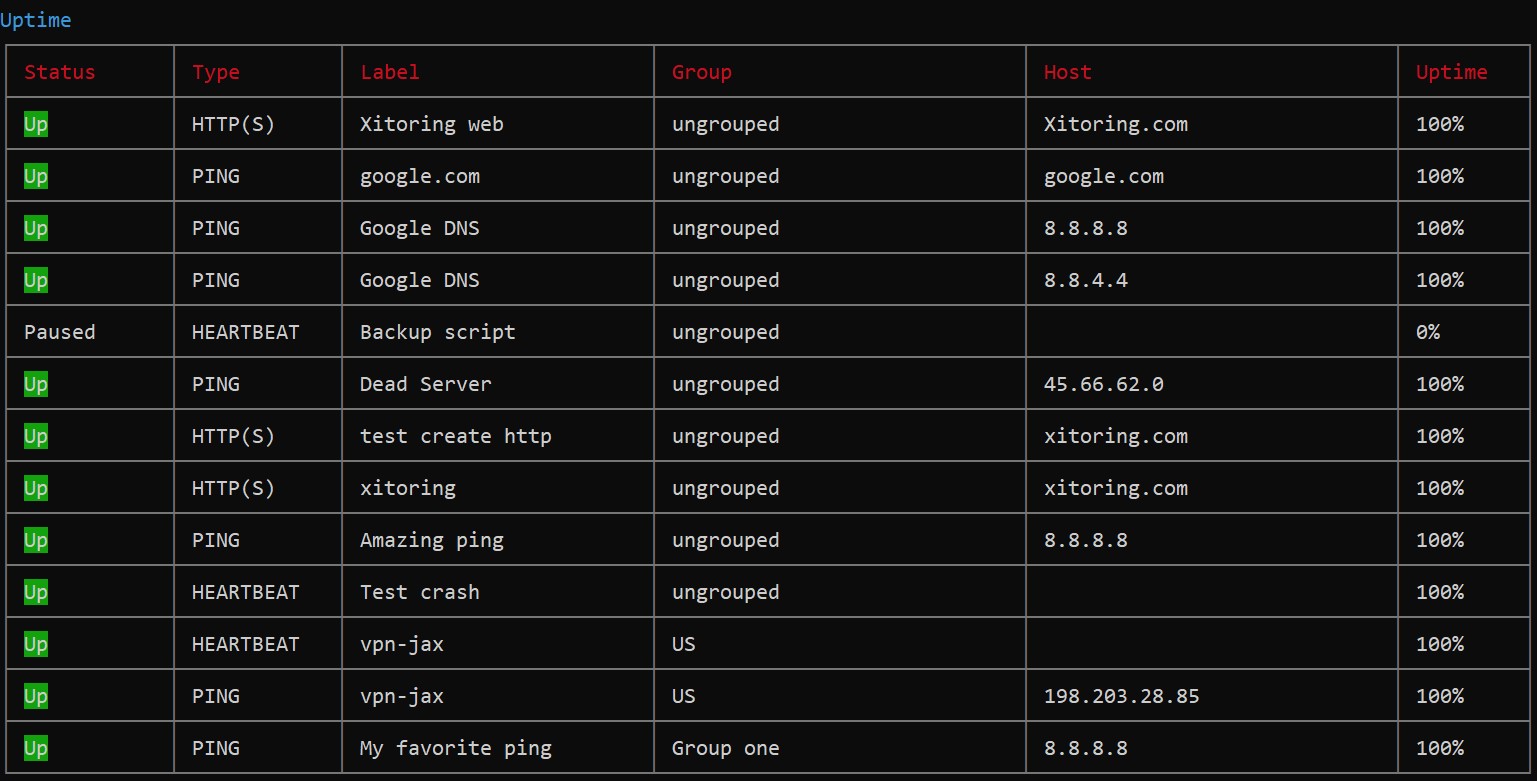
- List Uptime ChecksDisplay all uptime and heartbeat checks with their real-time status.
xitoring uptime
Examples with Flags
# Show only selected columns
xitoring uptime --columns=Status,Label,Type,Host

# Sort by uptime
xitoring uptime --sort=Uptime

# Filter by status
xitoring uptime --status=down

# Filter by check type
xitoring uptime --type=http

# Filter by period
xitoring uptime --period=this_month
Available Flags
--sort      : sort table by (Uptime, Label)
--columns   : customize table columns by (Status, Type, Label, Group, Host, Uptime)
--groups    : filter by group name
--status    : filter by status (up, down, pause, maintenance)
--period    : filter by period (today, this_week, this_month, last_month, this_year)
--type      : filter by check type (ping, http, ...)
SSL
List SSL Endpoints
xitoring sslDisplay all SSL endpoints and their certificate status.

Examples with Flags
# Show only selected columns
# Note: If your column names contain spaces (e.g., "Remaining Days"), wrap them in quotes.
xitoring ssl --columns=Status,Label,Host,Port,Issuer,Grade

# Sort by expiry
xitoring ssl --sort=Expire

# Filter by expire (e.g., expiring within 30 days)
xitoring ssl --expire=30

# Filter by group
xitoring ssl --groups=Websites
Available Flags
--sort      : sort table by (Expire, Label)
--columns   : customize table columns by (Status, Label, Host, Port, Issuer, Group, Grade, Remaining Days)
--groups    : filter by group name
--expire    : filter by expire
Help Output Reference
For detailed filter options and usage, you can run the contextual help for each section:
xitoring help --servers

Usage: xitoring servers <flags>

     --sort    : sort table by (CPU , Memory , OS , Label)
     --columns : customize table columns by (OS , Label , Checks , CPU , Memory , IO read , IO write , Group)
     --groups  : filter by group name
     --os      : filter by os (linux , windows)
xitoring help --uptime

Usage: xitoring uptime <flags>

     --sort    : sort table by (Uptime , Label)
     --columns : customize table columns by (Status , Type , Label , Group , Host , Uptime)
     --groups  : filter by group name
     --status  : filter by status (up , down , pause , maintenance)
     --period  : filter by period (today , this_week , this_month , last_month , this_year)
     --type    : filter by check type (ping , http , ...)
xitoring help --ssl

Usage: xitoring ssl <flags>

     --sort    : sort table by (Expire , Label)
     --columns : customize table columns by (Status , Label , Host , Port , Issuer , Group , Grade , Remaining Days)
     --groups  : filter by group name
     --expire  : filter by expire
Tip: Use equals-sign syntax with comma-separated values for flags that accept lists.
Examples:
xitoring servers --columns=OS,Label,CPU,Memoryxitoring uptime --columns=Status,Label,Type,Host
Example Workflow
# Login
xitoring login

# List servers with selected columns
xitoring servers --columns=OS,Label,CPU,Memory

# Show uptime checks for HTTP only
xitoring uptime --type=http --columns=Status,Label,Host

# Show SSL endpoints expiring in less than 30 days
xitoring ssl --expire=30 --sort=Expire
Revoking CLI Access
Currently, the Xitoring CLI does not include a direct logout command.
To remove access, you need to manually revoke the CLI API key from your Xitoring account:
- Go to Xitoring Account Settings.
- Locate the API Keys section.
- Delete the API key that was generated for your CLI session.
This will immediately revoke access for the CLI on your system.
Notes
- Use
xitoring helpfor a full list of commands. - Use
xitoring help --servers,xitoring help --uptime, andxitoring help --sslto see available filters and options. - Commands can be combined with flags for advanced filtering and customization.
- To log out, remove your API key from Xitoring Account Settings.